Which ten things does your business actually keep track of, and could an AI tell them apart?
Maria wants to open a coffee shop. Not her own: a Supreme Coffee. Supreme Coffee is a made-up coffee business that grows by franchise, so Maria fills in an application and sends it off.
Now, the first one to read it is not a person. An AI agent at the first stage reads Maria's application before anyone else does.
So let's ask the plain question. Reads what? One thing, with one name and one ID: the Franchisee Application. And everything a business runs on is made of things like that. We call them business objects.
So here is the question for this post: what are the things your business is actually about, and would an AI tell them apart?
Here is how the course opens this layer of the model.
Information is a layer of the model: a lesson from the AI Business Architect course. 1 minute 57 seconds, with sound.
Business objects first
A business object is a thing the business is actually about. An application. An agreement. A site. A store. We name these first, before anything else in this layer, because a concept with no object behind it is just a word.
Each business object gets a canonical name. Canonical just means the one agreed name: one name for one thing, the one people say out loud, chosen once and used everywhere. And it gets an ID, so the rest of the model can point at it.
Now, two checks.
First, business objects are things, not activities. "Franchise Compliance Monitoring" describes work. The object is the compliance record that work produces.
Second, a name is used once. So if the same thing turns up under two names, that is one object, and we choose one name for it.
Here are five of Supreme Coffee's business objects, and where each one turns up as a franchise application moves through its stages.
| Business object | ID | Where it turns up |
|---|---|---|
| Franchisee Application | BO-063 | Stage 1, when applications are evaluated |
| Franchise Agreement | BO-054 | Stage 3, when the agreement is executed |
| Franchise Site | BO-065 | Stage 5, when the site is confirmed |
| Franchise Store | BO-067 | Stage 6, when the store is prepared |
| Franchise | BO-056 | Every stage. Its state moves from Applied to Operating |
Five business objects from the Supreme Coffee model, in the order a new franchise meets them.
Look at the last row. The Franchise is the right Supreme Coffee grants for a territory. It is there at every stage, and its state moves on each time, from Applied all the way to Operating.
And the one who holds it? The Franchise Owner is a person, a stakeholder, never an object. Easy to say, and very easy to get wrong.
So, a question for you: where you work, which thing goes by three different names?
Why an AI cares what you call things
A language model writes the next words from what it has been given. It knows nothing about your business except what you put in front of it.
So put a paragraph in front of it, and it paraphrases. It reads well, and you cannot check a word of it.
Now put the object's row in front of it. A row is just one line in a table: one thing, described once. Its name, its ID, its definition, its state. Now the model has facts to quote, and you can check every one of them against the row.
That is the difference between an answer and an invention. So how do you tell which one you were given? This clip from the course shows you.
A grounded answer, and who answers for it: a clip from a lesson in the AI Business Architect course. 2 minutes 28 seconds, with sound.
Where each business object lives
Every one of your business objects lives somewhere, and naming that somewhere is architecture.
At Supreme Coffee, the Franchise Agreement lives in the Franchise Management System. So that system gets a row too. In architecture we call it an application, which here means a software system, not Maria's form.
The row says what the application is called, what it is for, and whether it is the system of record for what it holds. System of record just means the one place whose copy is the correct one.
And that is where we stop. The application is named, not designed. Its tables and fields belong to the technical architect.
So what does that give an agent? It looks the object up before it answers, from the place that holds it. For each of your own business objects, could you say which system holds the real one?
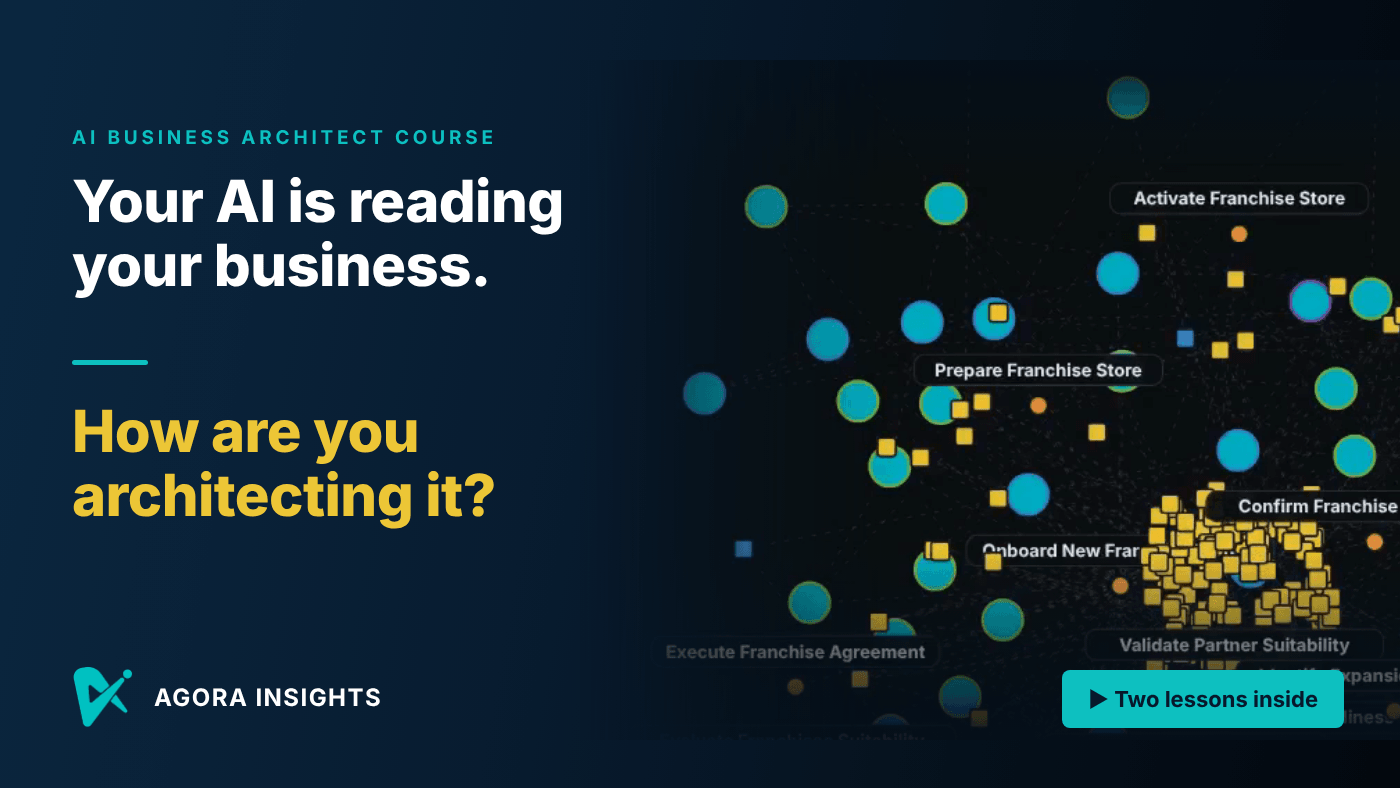
Here is the Dashboard reading Supreme Coffee's business objects. It is the free preview of the course: How to use the Business Architecture Dashboard.
Why naming things is architecting AI
The information layer used to be a diagram people read. If a name was a little off, somebody worked it out.
Now an agent reads the object's row every time it works. So if the name is wrong, or two names mean one thing, the agent is wrong the very next time it works. Nobody is there to work it out.
So naming your business objects, once, is architecting AI.
Try it today: ten minutes, your own AI app
You need ten minutes, the AI app you already use, and one document you are allowed to share with it.
- 1List ten business objects: the things your organisation is actually about.Not activities, things: a customer, an order, a permit, a claim, a site.
- 2Give each one name and a short ID.The name is the one people say.
- 3Write where each one lives.That is the system that holds the real one.
- 4Paste the list into your AI app with your documentand ask: "Which of these objects is this document about, and what state is it in?"
- 5Open a new chat, paste the document alone, and ask the same.
Now read the two side by side, and watch the difference between an answer and a guess. There you go.
See the model these videos come from
The free preview opens the Dashboard on Supreme Coffee, the model these videos come from.
Name your things once. Then architect with AI.
The AI Business Architect course is aligned with the BIZBOK® Guide and endorsed by the Business Architecture Guild®.
See the AI Business Architect course
Happy Learning, Deirdre
BIZBOK® and Business Architecture Guild® are trademarks of the Business Architecture Guild®. Supreme Coffee, Maria and Paul are fictional and are used for teaching. The videos are lessons from the AI Business Architect course.
FAQs
What is a business object?
A business object is a thing the business is actually about, such as an application, an agreement, a site or a store. Each one has one canonical name and an ID.
What is a canonical name?
It is the one agreed name for a thing: one name for one thing, the one people say out loud, chosen once and used everywhere.
Is an activity a business object?
No. Business objects are things, not activities. "Franchise Compliance Monitoring" describes work; the object is the compliance record that work produces.
Why do business objects matter to an AI?
A language model knows nothing about your business except what you put in front of it. Given a paragraph it paraphrases. Given the object's row, its name, its ID, its definition and its state, it has facts to quote, and you can check each one against the row.