
Table of Contents
- What the book sets out to do
- Q1: How real is the “legacy of failure”?
- Q2: Aren’t projects often about positioning, not delivery?
- Q3: What actually is a strategy?
- Q4: Of the Seven Deadly Patterns, which is the biggest silent killer?
- Q5: With AI, what’s the good — and what’s the block?
- Who this book is for
- FAQs
When Bill Ulrich joined me, I told him what I wanted: hard questions, the motivation behind the book, where he sees this going, and insights worth taking beyond the two of us. Bill is President of Tactical Strategy Group, co-founder of Business Architecture Associates, and co-founder of the Business Architecture Guild®. The book took three years to write, and it distils four decades of watching the same failure repeat. Let's get started :)
Strategy execution has a legacy of failure. The PwC, Standish Group, and MIT figures have barely moved in twenty years. Frameworks, tools, and consulting spend keep growing — and strategies keep stalling somewhere between the slide deck and the shop floor.
Watch the interview here:
What the book sets out to do
From our conversation, this is not another “align strategy and IT” pamphlet. It is a working framework: how to take a strategic intent all the way through impact assessment, architecture, initiative design, and deployment without the usual breaks in the chain.
What stood out as Bill talked it through:
- It treats execution as a designed system, not a project portfolio that appears after the offsite
- It is methodology-agnostic without being vague — it borrows from known practice and still insists on one connected path
- It puts impact assessment and future-state architecture back where they belong: before scope and money are locked
- It is blunt about accountability — leadership cannot outsource the thinking to a third party with little stake in the long-term result
What it is not: a light read, or a substitute for doing the architecture work. If you want a weekend summary of Agile-plus-OKRs, look elsewhere. The value is in the connected path, not in a new acronym.
Rather than walk through the chapters, I’ll walk through the questions I took into the interview — what Bill said, and where I stand.
Q1: How real is the “legacy of failure”?
I opened by putting the book’s own phrase back to Bill: strategy execution has a legacy of failure, and it hasn’t changed much over the years. What does he mean by that? And how real is the failure — outright, or just getting halfway?
Bill did not treat the failure as “we only got halfway.” A great deal of work gets funded, a great deal of activity happens, and too little is checked against the outcome that justified the spend. The deeper problem, as he put it:
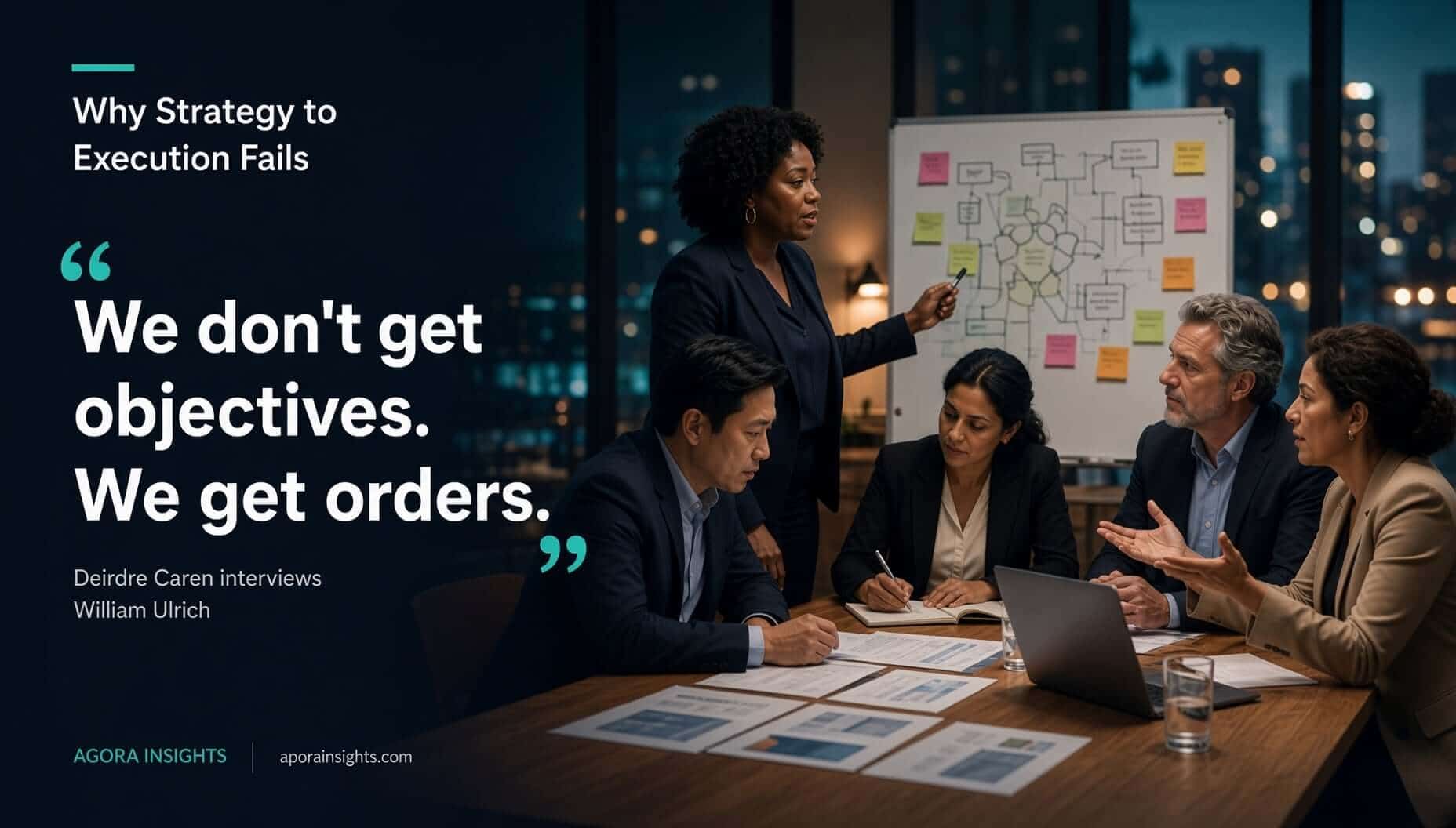
Deploy AI. Do digital transformation. Stand up the platform. Too many “strategies” are mandates dressed up as objectives. A real strategy, as Bill defines it, has goals, SMART objectives, KPIs, and explicit courses of action. A mandate has none of those — so you can complete it and still not know if the business won.
Q2: Aren’t projects often about positioning, not delivery?
This was the less polite observation I put to him directly: in my experience, projects, programmes — even strategies — are often not really about delivery at all. They are about positioning. The measure becomes almost irrelevant; what matters is getting positioned for the next role, in this organisation or the one you’re going to next. I learned this the hard way — I didn’t realise the purpose was positioning, not delivering. And it happens more often than we think.
Bill didn’t flinch. He connected it to the integrator “daisy chain”: study, proof of concept, another study — a chain of engagements where nobody is accountable for the deployed outcome. His cautionary case was the US Veterans Administration’s patient-tracking replacement: costs moved from about US$10 billion to US$16 billion, still without a working replacement.
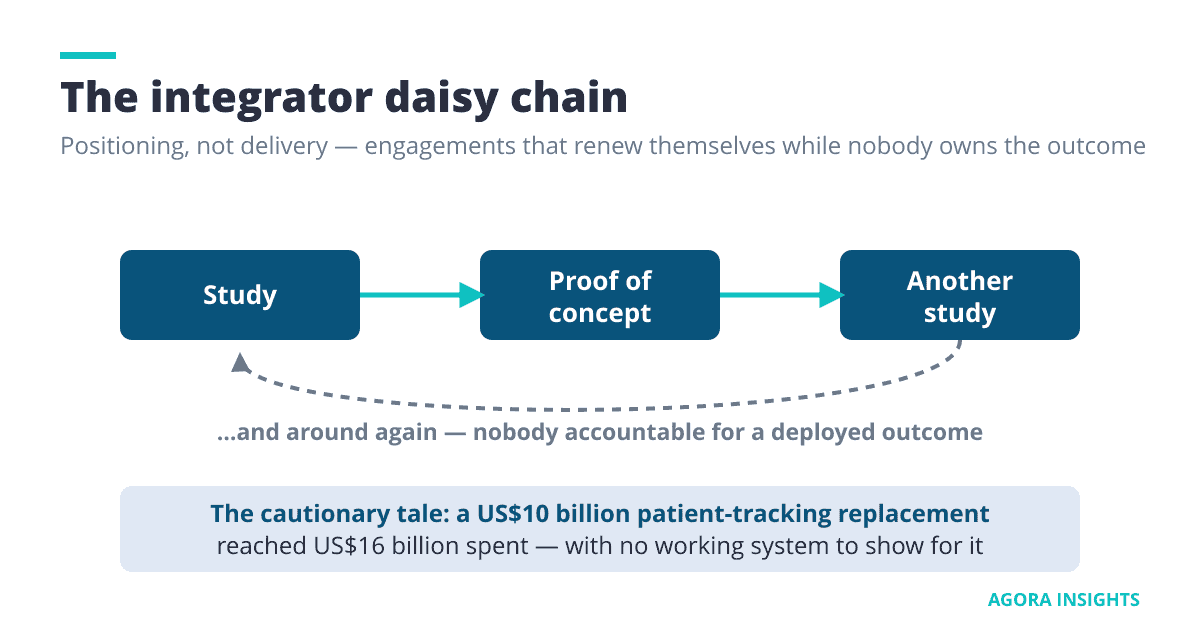
My view: late detection of failure is itself a failure. Impact assessment exists to make trouble visible before spend becomes politically unstoppable. That is where the book earns its keep — it is trying to surface failure early, while there is still a decision to make.
Q3: What actually is a strategy?
I asked because I do not think we are honest enough about what a strategy is.
Most people hear “strategy” and think “the next project.” That is how to play. A strategy is how to win. It is a choice made under uncertainty — which market, which customers, which capabilities we will back, and which we will not. If the path is already obvious, it is a plan. If it only names a programme, it is a mandate. A real strategy should feel slightly uncomfortable. It asks the organisation to leave a familiar way of working and take a risk.
That is why I look for capabilities inside the strategy, not after it. At a strategic level we should be able to see which parts of the architecture are being put in play — and which are not. If that is missing, execution teams are left to implement a slogan.
Bill tied the definition back to execution. Once a strategy has real goals, measurable objectives, and explicit courses of action, the next two steps are the ones most organisations skip: impact assessment and future-state architecture. That is the connected path the book is built around. It usually breaks in three places:
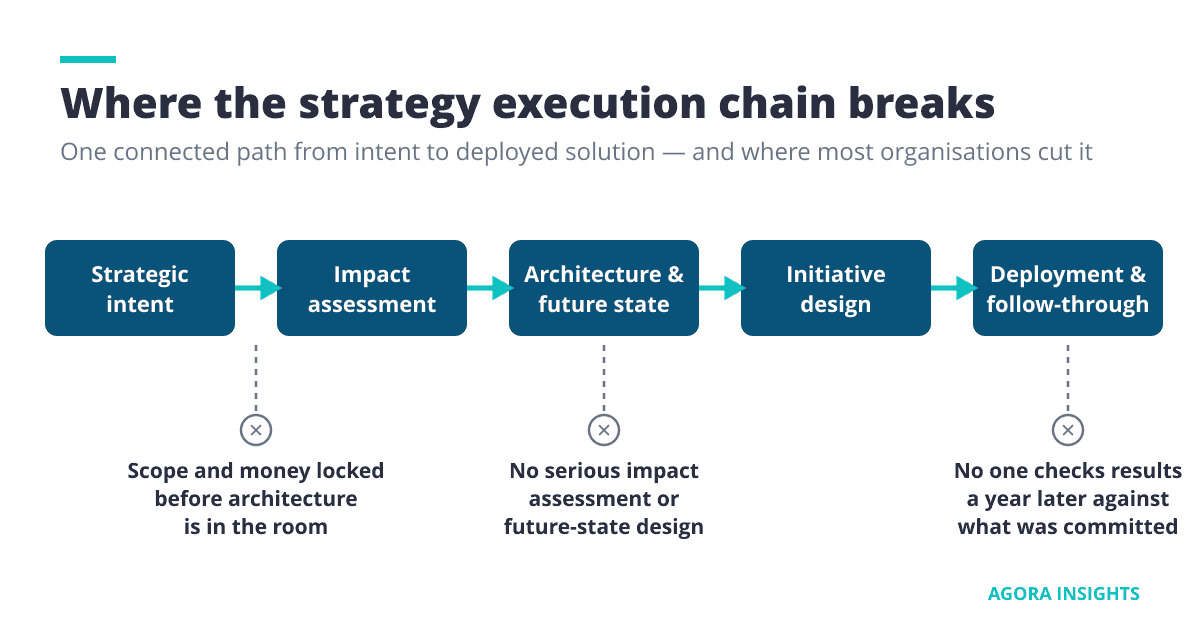
- Scope is locked before architecture is in the room
- There is no serious impact assessment or future-state design
- Nobody checks a year later against what was actually committed
Q4: Of the Seven Deadly Patterns, which is the biggest silent killer?
The book calls out Seven Deadly Patterns behind execution failure. I asked Bill to pick one from the seven: which is the biggest silent killer?
Bill’s answer: culture, politics, and silos sit at the top — but data is the weak link. Technology is hard, yet it is rarely what stops an organisation cold. His examples of shadow systems stayed with me: a fund manager running on 25,000 spreadsheets, and a manufacturer whose assembly line stops without them.
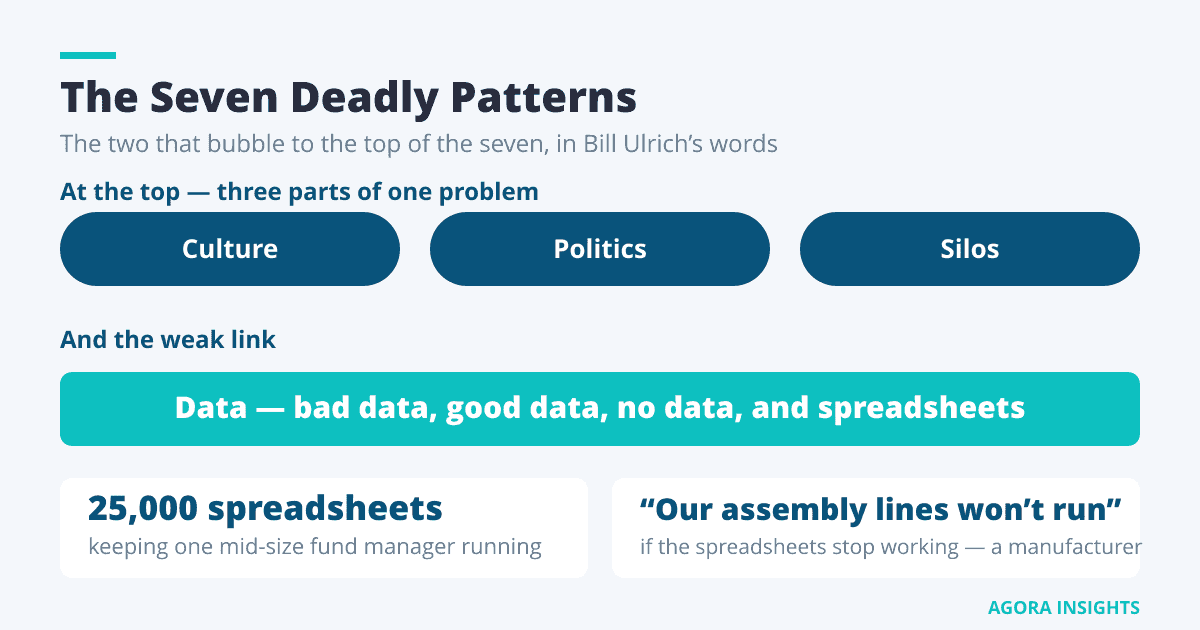
My view: I see the same damage. Businesses still run on bad data, good data, no data, and spreadsheets. Everywhere. The caution I’d add — and Bill’s long-game view supports it — is that there is a difference between perfect data and what we can do now. Architecture helps because it gives you an information map and a small set of business objects — Bill talked in terms of 60 to 80 — so you can improve operational data and retire shadow systems over years, not sprints.
Data is a business problem. Until leadership treats it that way, AI programmes will inherit the same mess and call it transformation.
Q5: With AI, what’s the good — and what’s the block?
Before we closed, I asked Bill to look ahead: with AI, architecture, and strategy execution, what does he see as the good — and what does he see as the block?
The good, for Bill, is the cognitive enterprise — the subject of the book’s AI chapter: AI helping with impact assessment, goal generation, and initiative triage, with architecture as the knowledge base those agents work from. The block is readiness: most organisations are nowhere near ready for the AI they have been mandated to deploy.
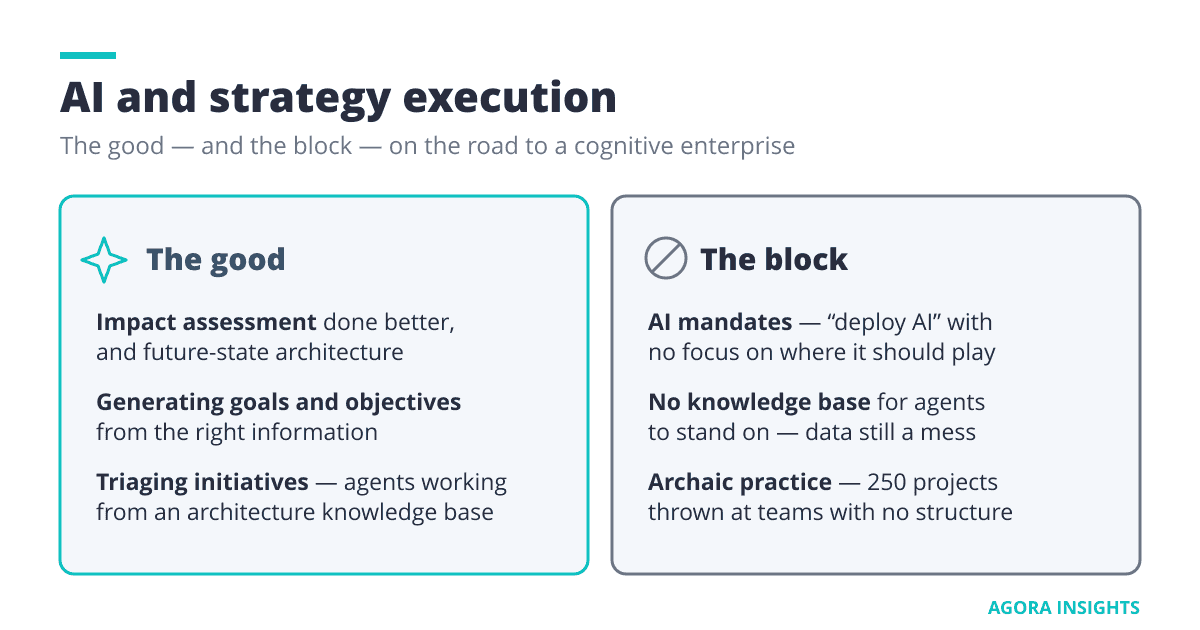
My view is more cautious. Many organisations are not even at the early stage of thinking that through. AI on top of mandates and silos does not create a cognitive enterprise. It creates faster confusion. The knowledge base has to exist before the agents can stand on it.
Who this book is for
If the conversation is anything to go by, it will earn its keep for executives tired of strategies that die in delivery, architects asked to “support” work that was scoped without them, and transformation leads who can see the daisy chain forming and need language for it. I will be going back to the framework chapters — particularly impact assessment and the long game on data.
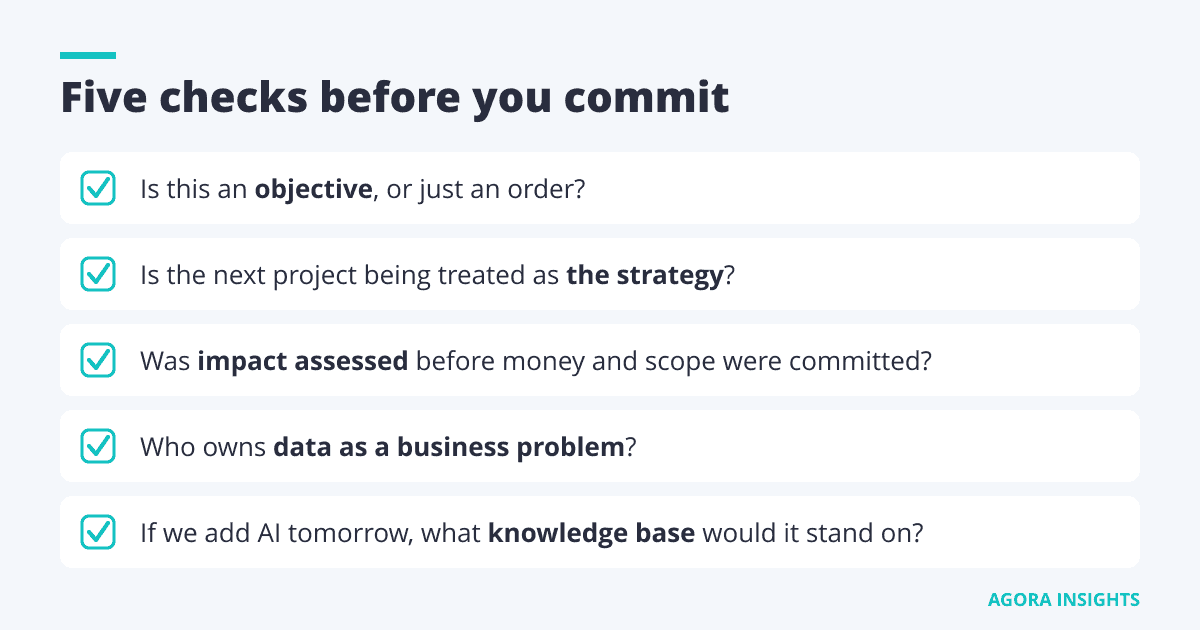
If I had to compress the conversation into five checks for practitioners:
- Is this an objective, or just an order?
- Is the next project being treated as the strategy?
- Was impact assessed before money and scope were locked?
- Who owns data as a business problem?
- If we add AI tomorrow, what knowledge base does it stand on?
End-to-End Strategy Execution: From Inception Through Solution Deployment — Charles F. Bowman and William M. Ulrich, published December 2025, roughly 350 pages.
Watch the conversation · Get the book: Routledge or Amazon (ISBN 9781032451268 — hardcover, paperback, and ebook)
Happy Learning,
Deirdre
Business Architecture Guild® is a trademark of the Business Architecture Guild®.
FAQs
Why does strategy execution keep failing?
Because most organisations are not executing a strategy at all — they are executing a mandate. "Deploy AI" or "do digital transformation" arrives with scope and funding already set, no goals, no measures, and no architecture behind it. You can complete the mandate and still not know whether the business won.
What is the difference between a strategy and a mandate?
A strategy is a choice made under uncertainty: which markets, which customers, which capabilities you will back, and which you will not. It has goals, measurable objectives, KPIs, and courses of action. A mandate just names a programme and tells people to deliver it.
What are the Seven Deadly Patterns of strategy execution?
They are the recurring patterns behind execution failure set out in End-to-End Strategy Execution. In the interview, Bill Ulrich put two at the top: culture, politics and silos on one hand, and data as the weak link on the other. Technology is hard, but rarely the thing that stops an organisation cold.
Why is data a business problem rather than an IT problem?
Because the business runs on it. Bill described a fund manager operating on 25,000 spreadsheets and a manufacturer whose assembly lines stop if the spreadsheets stop — not if the ERP fails. Shadow systems like these are business decisions with business consequences, so leadership has to own the plan to fix them.
What is impact assessment, and why does it matter so much?
It is the step where you work out what a strategy will actually affect — capabilities, value streams, information, systems — before scope and money are locked. Skip it and failure only surfaces late, when the spend is politically unstoppable. Done properly, it makes trouble visible while there is still a decision to make.
What is a cognitive enterprise?
It is the idea that architecture becomes the knowledge base AI agents work from, rather than something produced only for human consumption. Bill sees AI genuinely helping with impact assessment, generating goals and objectives, and triaging initiatives — but only once that knowledge base actually exists.
Will AI fix strategy execution?
Not on its own. An AI mandate without focus, without good data, and without an architecture knowledge base for agents to stand on does not create a cognitive enterprise — it creates faster confusion. The structural work has to come first.
Where can I learn business architecture?
Agora Insights is a Guild Accredited Training Partner™ of the Business Architecture Guild®, delivering business architecture training and CBA® certification preparation alongside advisory work with organisations and practitioners worldwide.